You have saved some money, you keep hearing that property builds wealth, and you are looking at listings in Raleigh, Greenville, or a smaller town like Tarboro. The numbers look promising on paper. Still, one question keeps coming back: is this a smart long-term move, or an expensive way to tie up your savings?
That question deserves a serious answer. Property is a large purchase, it cannot be sold in a day, and small mistakes in pricing, financing, or upkeep can take years to fix. North Carolina and the wider Southeast offer real opportunity, but every market behaves differently, and what works in one county may fail in the next.
This guide explains real estate investment in plain terms. You will learn how it builds wealth, the main ways people approach it, why management matters after closing, and which risks deserve your attention. No property delivers guaranteed returns, so the goal here is to help you ask better questions before you commit capital.
What Real Estate Investment Means and How It Builds Wealth
At its simplest, real estate investment means buying property to earn a return through rent, resale, or both. Unlike a stock, you own a physical asset that you can improve, finance, and manage. That level of control is a big reason many people use property to build wealth over decades instead of months.
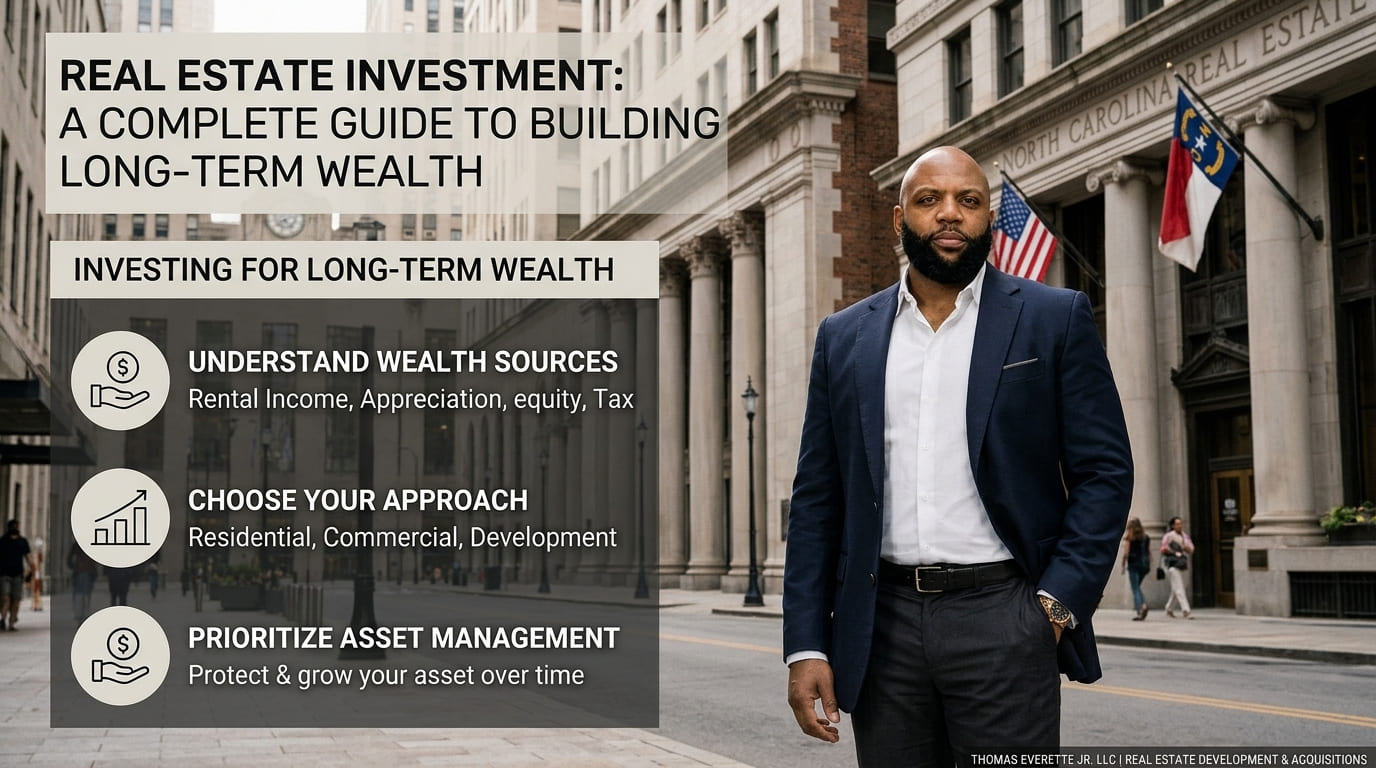
Wealth usually comes from four sources working together: rental income, appreciation, loan paydown, and tax treatment. None of them is guaranteed, and each depends on the property, the market, and how well the deal was underwritten. Understanding each one helps you judge whether a deal fits your goals.
Rental Income and Cash Flow
Cash flow is the rent left after operating costs and debt payments. A property with healthy cash flow can carry itself through slow periods and give you room to handle repairs. Careful real estate investors use conservative assumptions for vacancy and maintenance, because the first year rarely goes exactly as planned.
Appreciation, Equity, and Tax Considerations
Appreciation is the increase in a property's value over time. It depends on local job growth, housing supply, and neighborhood demand, so it should never be treated as a sure thing. Equity also grows as tenants' rent helps pay down the mortgage, which is often the quieter driver of long-term wealth.
Tax rules, such as depreciation, can also affect your results. These rules change and vary by situation, so speak with a qualified CPA before you buy. For broader housing information and research, explore HUD's housing research and data.
Ways to Approach Real Estate Investing in North Carolina and the Southeast
There is no single path into real estate investing. Some people start with one rental home, while others move into apartment communities, commercial buildings, or land. The right choice depends on your capital, your time, and how hands-on you want to be.
Residential and Multifamily Properties
Single-family rentals are easier to understand and finance, which makes them a common starting point. Multifamily properties, such as apartment communities, spread income across many units, so one vacancy hurts less. Workforce and affordable housing also deserve a look, since demand for attainable homes remains strong in many Southeastern communities.
Commercial and Mixed-Use Properties
Retail, office, industrial, and mixed-use buildings often involve longer leases and professional tenants. They can also carry more risk if a major tenant leaves. Commercial deals reward patience and careful lease review, so they usually suit people with more experience or strong partners.
Development and Repositioning
Real estate development means building something new or significantly improving what is already there. It can create more value than buying a finished property, but it also takes more time, capital, and planning. Thomas Everette Jr. LLC outlines its approach on its development projects page, which is a useful reference if you are comparing buying with building.
Why Asset Management Decides Long-Term Results
Buying the property is only the first step. Asset management is the ongoing work of protecting and improving a property's value after closing. That includes setting rents, controlling expenses, planning repairs, screening tenants, and deciding when to hold, refinance, or sell.
Many deals that looked strong at purchase struggle because no one watched the details afterward. Deferred maintenance, slow rent adjustments, and weak tenant communication can quietly drain returns. Good asset management treats the building as a business, with budgets, reports, and regular reviews. Thomas Everette Jr. LLC describes its long-term ownership focus on its investment portfolio page.
Risks Every Investor Should Plan For
Every property carries risk, and honest planning starts with naming it. Interest rates can change your financing costs. Vacancies can last longer than expected. Roofs, HVAC systems, and plumbing can fail at inconvenient times. In coastal and low-lying parts of North Carolina, flood and storm exposure also deserve a close look, including insurance costs.
You cannot remove these risks, but you can prepare for them. Keep cash reserves, avoid borrowing more than the property can comfortably support, and complete thorough due diligence before closing. For background on interest rates and credit conditions, the Federal Reserve's economic data and research provides useful information.
A Practical Way to Evaluate Your First Deal
A simple, repeatable process keeps emotion out of the decision. The steps below work for most residential and small commercial properties, and you can adjust the depth based on the size of the deal.
- Define your goal, such as monthly income, long-term growth, or a mix of both.
- Study the neighborhood, including employment, nearby supply, and rent levels.
- Estimate income and expenses using conservative numbers.
- Inspect the physical condition and price in the repairs you will need.
- Review financing terms and confirm the deal still works if costs rise.
- Decide who will manage the property and what that will cost.
If you own property and are considering a sale, you can learn how the company reviews opportunities on its acquisitions page. Whatever your situation, avoid rushing. A good deal can survive careful questions, and a weak one usually cannot.
Conclusion
Real estate investment can build lasting wealth when you buy with discipline, plan for risk, and manage the property well after closing. Income, loan paydown, appreciation, and tax treatment each play a role, but none is guaranteed. The investors who do best tend to be patient, conservative with their numbers, and realistic about what ownership requires.
Thomas Everette Jr. LLC is a North Carolina-based company focused on acquisition, development, and management of residential, multifamily, commercial, and mixed-use properties, with an emphasis on affordable and workforce housing. If you are exploring a joint venture or equity partnership, the investor relations page explains how the company approaches those conversations.
If you have a property to discuss or want to learn how a partnership could work, we would like to hear from you. Contact our office to start a direct, no-pressure conversation about your goals and the opportunity in front of you.